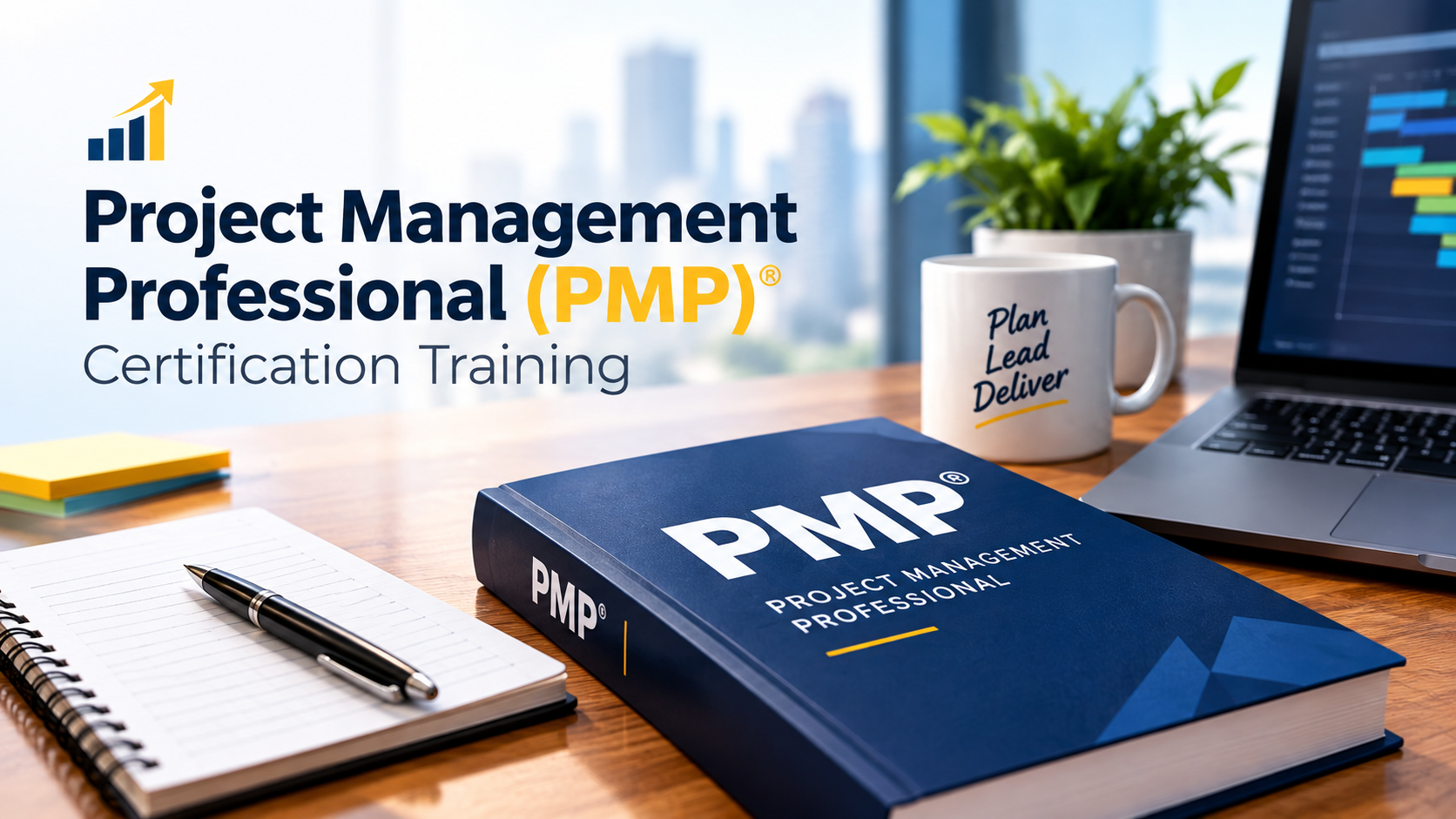
Project Management Professional (PMP) Certification Training
Course Introduction The Project Management Professional(PMP)® credential is the most globally recognised certification for projectmanagers, issued by the Project Management Institute (PMI®). It validates aprofessional’s ability to lead and direct projects across predictive(waterfall), agile, and hybrid approaches — the three ways of working that PMI®recognises as equally valid in the modern project environment. Procert Academy’s PMP®Certification Training is a 5-day, instructor-led intensive designed to takeparticipants from working project experience to full exam readiness. The courseis built directly against the current PMI® Examination Content Outline (ECO)and covers the three ECO domains — People, Process, and Business Environment —in the same proportions the exam itself weights them, so that classroom timemirrors exam time. Delivery combines structured instruction, PMBOK® Guide andAgile Practice Guide concepts, real project scenarios from the Nigerian oil& gas, construction, telecoms, and public-sector environments, situationalpractice questions, and a full-length mock exam with review. Participants leave with all 35contact hours of project management education required to apply for the PMP®exam, a working command of predictive, agile, and hybrid techniques, and astructured personal study plan for the final stretch to exam day. Course Objectives By the end of this course, participants will be able to:
Course Curriculum
1
· Project, programme, and portfolio management; the role of the PMO
· Project life cycles: predictive, iterative, incremental, agile, and hybrid approaches
· The PMI® Talent Triangle®: Ways of Working, Power Skills, Business Acumen
· Organisational structures and their influence on project authority (functional, matrix, projectised)
· Project selection, business case, and benefits management
· Stakeholder identification and the project charter
· Tailoring the approach to the project and organisational context
2
· Building and leading effective project teams; team charters and ground rules
· Servant leadership and situational leadership styles
· Managing conflict, negotiation, and difficult conversations
· Emotional intelligence and influencing without authority
· Virtual, cross-cultural, and distributed team management
· Mentoring, coaching, and supporting team performance
· Stakeholder engagement planning and management
3
· Empowering team members; removing impediments and blockers
· Managing resource needs, onboarding, and team resourcing
· Scope management: collecting requirements, defining scope, WBS, scope validation and control
· Schedule management: activity sequencing, estimating, critical path, schedule compression
· Cost management: budgeting, cost baseline, earned value management (EVM: PV, EV, AC, CPI, SPI)
Agile planning: product backlog, user stories, story points, release and iteration planning4
· Quality management: quality planning, assurance, control, and continuous improvement
· Resource management: physical and team resource planning and control
· Communications management: planning and managing information flow
· Risk management: identification, qualitative/quantitative analysis, response planning, monitoring
· Procurement management: contract types, vendor selection, and contract administration
· Integration management: project charter to closure, change control, and configuration management
· Issue log, lessons learned, and knowledge management
5
· Compliance, legal, and regulatory considerations for projects
· Delivering business value and benefits realisation
· Organisational change management and external business environment changes
· Hybrid approaches: blending predictive and agile elements on a single project
· Agile frameworks overview: Scrum, Kanban, Lean, and Scrumban
· PMP® exam structure, question formats (multiple choice, multiple response, matching, hotspot, limited fill-in-the-blank), and time management strategy
· Full-length timed mock examination and guided answer review
· Personal study plan and revision roadmap to exam day
6
This course is designed forexperienced project practitioners who meet, or are close to meeting, PMI®’s PMP®eligibility requirements:
· Engineers, site/construction supervisors, andtechnical leads who manage project scope, schedule, or budget
· Oil & gas, construction, telecoms, andpublic-sector professionals responsible for delivering projects
· Professionals preparing to sit the PMP® exam whoneed a structured, exam-focused review
Note on eligibility: PMI® additionally requires 35 hours of projectmanagement education, which this course satisfies in full. Participants shouldconfirm their individual eligibility against PMI®’s published requirementsbefore applying to sit the exam.
This course includes
- 6+ Activity Modules
- 40 hours + lessons
- Lifetime access
- Certificate of completion
- Available on desktop and mobile
What Our Participants Say
Hear from participants who have experienced our training.
The facilitator’s wealth of experience was both striking and beneficial. He really helped translate concepts to real life.
The practical session where step by step of the lecture is broken down in visual and practice
I enjoyed the interactivity. It was also very direct, pointing out to us the key things to look for in the bidding, tender and proposal administration process, while also ensuri...
The practical session of the class which helped in giving a live run through of the necessary bidding and tender platform
The atmosphere was very pleasant, as it was an interactive and engaging session, which I personally enjoyed.
Some of Our Partners